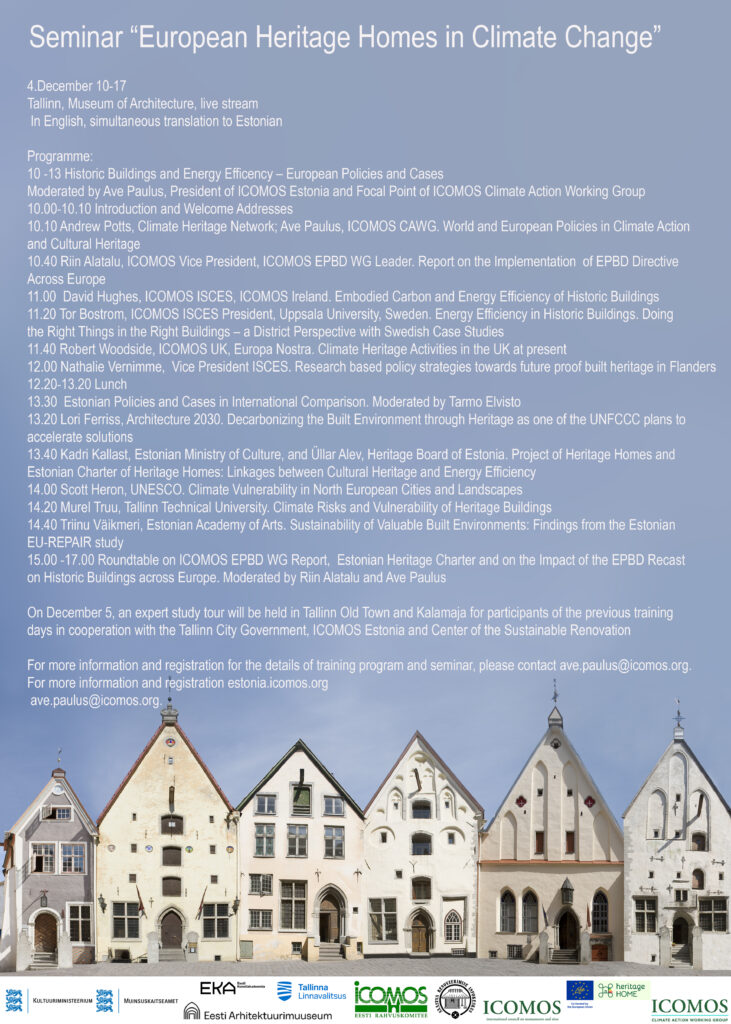
ICOMOS Climate Literacy Training and Tallinn Seminar for European Historic Homes
On December 3-5, the Estonian Committee of the international expert organization for heritage conservation, ICOMOS, in cooperation with the ICOMOS Climate and Heritage Working Group, the ICOMOS European Energy Directive Working Group, the ICOMOS Energy Efficiency Scientific Committee, the Tallinn City Government, the Estonian Heritage Board, the Ministry of Culture, the Life HeritageHomes project team, heritage communities and several other partners, will organize a climate and heritage training program with open seminars. The training and seminars, which will take place in Tallinn and online, are aimed at heritage specialists and communities in Estonia and the European countries.
Link in Estonian
Inglisekeelne striim
This is a three-day program consisting of training and open seminar:
- Climate Literacy Training for Cultural Heritage Experts on December 3rd from 9 am to 5 pm at the Statehood House and Zoom. In English
- Open Seminar and Think Tank “European Heritage Homes in Climate Change” on December 4th from 10 am to 5 pm in the Tallinn Museum of Architecture and online. In English, simultaneous translation to Estonian.
- Expert Study Tour in Tallinn Old Town and Kalamaja on December 5th
On December 3rd, ICOMOS Climate Literacy Training for Heritage Professionals (CLTH) will take place in the Statehood Building of Tallinn and online. In English.
ICOMOS Climate Literacy Training for Heritage Professionals (CLTH) builds on a resource designed by the ICOMOS Climate Action Working Group (CAWG) through the Preserving Legacies project funded by the National Geographic Society and aims to develop place- and cultural heritage-based climate adaptation actions, transforming conservation practice as a field to meet the challenges of the climate crisis.
The content of the CLTH is in line with key international documents, including the UNESCO Policy Document on Climate Action for World Heritage, the Paris Agreement on the United Nations Framework Convention on Climate Change, and is an important step towards achieving the goals of the Global Adaptation Goal, which calls on Parties to develop “adaptive strategies to preserve cultural practices and heritage sites and to build climate-resilient infrastructure, guided by traditional knowledge, indigenous knowledge and local knowledge systems”.
The climate literacy training for heritage professionals addresses key topics identified as baseline competencies for heritage professionals in the ICOMOS Future of our Pasts Report (2019).
These are:
- Climate Science and Impacts – This module will introduce participants to climate change and how it impacts both the world and heritage.
- Carbon Footprints and Vulnerability – This module will encourage participants to understand the carbon footprint of the heritage sector and introduce vulnerability and how it is assessed.
- Adaptation and Mitigation – This module will encourage participants to consider their own, and heritage’s, contributions to climate action through sustainable adaptation and mitigation pathways
- Climate Justice and Equity – This theme will be addressed throughout other modules and discusses the important topics of climate justice and equity, focusing on how we can ensure respectful and equitable interactions and engagement in climate action.
Additional modules include:
- Climate Action for World Heritage
- Climate Vulnerability of North European Cities and Landscapes
Training is held by Will Megarry, Ave Paulus and Scott Heron.
The training is targeted to Nordic-Baltic heritage experts and ICOMOS members from Europe. The training will be held in English. The training materials will be translated later into Estonian.
Registration link https://forms.gle/viFxHiDFzRyKac9i8
Contact: Ave Paulus, ave.paulus@icomos.org
On December 4, an open seminar “European Heritage Homes in Climate Change” will be held in Tallinn Museum of Architecture and online. In English, simultaneous translation into Estonian
The importance of European historic buildings in achieving climate goals is a central topic in the world and in Europe in light of the Energy Directive, and this is also the main topic of the open seminar to be held on December 4. Speakers from Europe will present the experiences of different countries in achieving climate goals for historic buildings, including examples from Great Britain, Ireland, Belgium, and Estonia. We will present the results of the ICOMOS EPBD working group on European experience in implementing the Energy Efficiency Directive. Climate and heritage guidance material is being compiled within the framework of the Estonian Heritage Homes project. We will discuss the guidance materials for historic buildings prepared by this project and the preparation of a heritage charter. The seminar, which will be held with the participation of well-known European experts, is a good opportunity for international cooperation on heritage and climate issues in Estonia. We invite all those involved in historic buildings to participate and contribute to the discussion. The seminar will be held in a hybrid format. The working language of the seminar is English, with simultaneous interpretation in Estonian.
Programme/programm:
10 -13 Historic Buildings and Energy Efficency – European Policies and Cases
Moderated by Ave Paulus, President of ICOMOS Estonia and Focal Point of ICOMOS Climate Action Working Group
10.00-10.10 Introduction and Welcome Addresses
10.10 Ave Paulus, ICOMOS CAWG. World and European Policies in Climate Action and Cultural Heritage
10.40 Riin Alatalu, ICOMOS Vice President, ICOMOS EPBD WG Leader. Report on the Implementation of EPBD Directive Across Europe
11.00 David Hughes, ICOMOS ISCES, ICOMOS Ireland. Embodied Carbon and Energy Efficiency of Historic Buildings
11.20 Tor Bostrom, ICOMOS ISCES President, Uppsala University, Sweden. Energy Efficiency in Historic Buildings. Doing the Right Things in the Right Buildings – a District Perspective with Swedish Case Studies
11.40 Robert Woodside, ICOMOS UK, Europa Nostra. Climate Heritage Activities in the UK at present
12.00 Nathalie Vernimme, Vice President ISCES. Research based policy strategies towards future proof built heritage in Flanders
12.20-13.20 Lunch
13.30 Estonian Policies and Cases in International Comparison. Moderated by Tarmo Elvisto
13.20 Lori Ferriss, Architecture 2030. Decarbonizing the Built Environment through Heritage as one of the UNFCCC plans to accelerate solutions
13.40 Kadri Kallast, Estonian Ministry of Culture, and Üllar Alev, Heritage Board of Estonia. Project of Heritage Homes and Estonian Charter of Heritage Homes: Linkages between Cultural Heritage and Energy Efficiency
14.00 Scott Heron, UNESCO. Climate Vulnerability in North European Cities and Landscapes
14.20 Murel Truu, Tallinn Technical University. Climate Risks and Vulnerability of Heritage Buildings
14.40 Triinu Väikmeri, Estonian Academy of Arts. Sustainability of Valuable Built Environments: Findings from the Estonian EU-REPAIR study
15 -17 Roundtable on ICOMOS EPBD WG Report, Estonian Heritage Charter and on the Impact of the EPBD Recast on Historic Buildings across Europe. Moderated by Riin Alatalu and Ave Paulus
On December 5, an expert study tour will be held in Tallinn Old Town and Kalamaja for participants of the previous training days in cooperation with the Tallinn City Government, ICOMOS Estonia and Center of the Sustainable Renovation
For more information and registration for the details of training program and seminar, please contact ave.paulus@icomos.org.
Please register yourself! Places and spaces are limited! Link https://forms.gle/viFxHiDFzRyKac9i8